With more than 10‑year industry experience, Shandong Headpowder delivers full‑service pneumatic‑conveying systems and blowers, undertaking nationwide turn‑key powder‑handling projects.
For industries dealing with magnesium oxide powder, efficient material handling is crucial to maintain production efficiency and product quality. Pneumatic conveying equipment offers a reliable solution for transporting these fine powders over short to medium distances. This article provides an overview of the operation process and working principle of such equipment, focusing on the specific requirements of magnesium oxide powder handling.
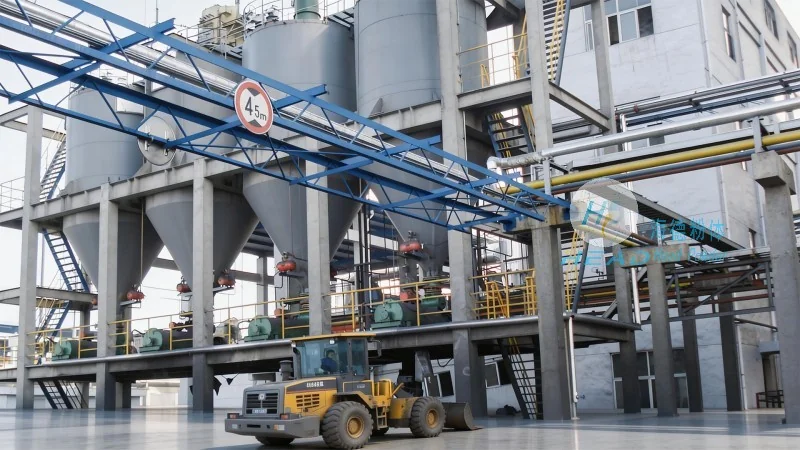
HeadPowder, a leading manufacturer in the field of material handling equipment, specializes in designing and manufacturing pneumatic conveying systems tailored to the needs of various industries. With a strong commitment to quality and innovation, HeadPowder has established itself as a trusted partner for businesses seeking efficient and reliable solutions for powder handling. The company’s headquarters is located in Shandong, China, where it leverages advanced technology and expertise to develop cutting-edge equipment for the global market.
A typical pneumatic conveying system for magnesium oxide powder consists of several key components that work in tandem to ensure smooth material transport. These components include a hopper or storage silo for powder storage, a feeder to control the flow rate of the powder, a conveying line (often equipped with a pipeline and air compressor), and a receiver or discharge point where the material is deposited. The air compressor generates the necessary pressure or vacuum to move the powder through the system, while the feeder ensures a consistent and controlled feed rate to prevent blockages or uneven flow.
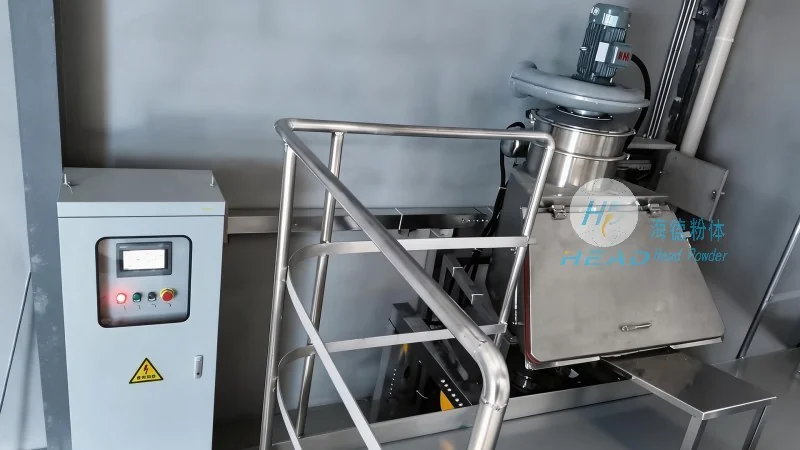
The operation process of a magnesium oxide powder pneumatic conveying system involves several sequential steps. First, the magnesium oxide powder is fed from the storage hopper into the feeder. The feeder then regulates the flow rate, ensuring a steady supply of powder to the conveying line. Simultaneously, the air compressor produces compressed air, which is introduced into the conveying line. The compressed air creates a flow that carries the powder particles through the pipeline. As the powder travels, it is mixed with the air stream, forming a suspension that moves towards the receiver. The receiver is typically a container or silo where the powder is deposited after the air is separated from the material. The entire process is automated and can be controlled remotely, allowing for precise management of the material flow and system performance.
The working principle of pneumatic conveying relies on the interaction between the powder particles and the air stream. In a pressure system, compressed air is used to push the powder through the pipeline, while in a vacuum system, the air is drawn to pull the powder from the source to the destination. For magnesium oxide powder, which is a fine and potentially abrasive material, the system is designed to minimize particle degradation and ensure efficient transport. The key principles include maintaining a consistent air velocity to prevent particle settling or blockages, controlling the air-to-powder ratio to optimize energy efficiency, and using appropriate pipeline materials to withstand the abrasive nature of the powder. The system also incorporates features such as air filtration and dust collection to ensure environmental compliance and product purity.
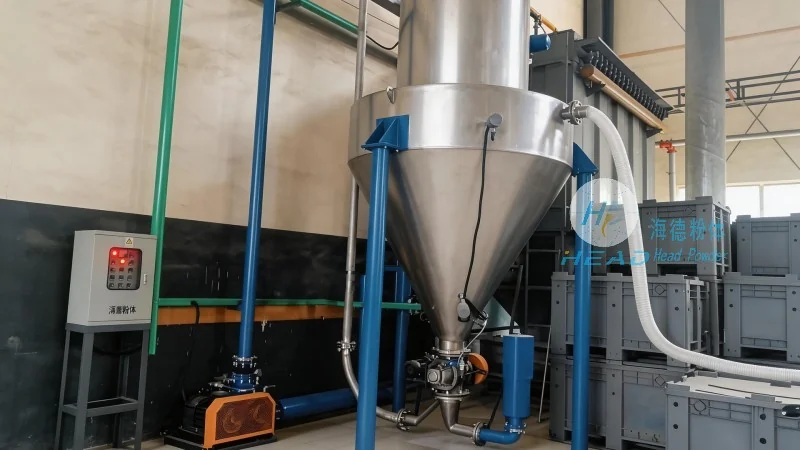
Employing pneumatic conveying equipment for magnesium oxide powder offers several advantages over traditional methods like belt conveyors or bucket elevators. These benefits include the ability to transport the powder in a closed system, which reduces dust emissions and improves workplace safety. The system also allows for gentle handling of the powder, minimizing particle breakage and preserving the material's quality. Additionally, pneumatic conveying can handle varying flow rates and distances, making it suitable for both small-scale and large-scale production environments. The automated nature of the system reduces labor costs and improves operational efficiency, contributing to overall cost savings for the business.
HeadPowder’s pneumatic conveying systems are designed to be versatile and customizable to meet the specific needs of different applications. Whether for short-distance transport within a facility or longer-distance transfer between buildings, the systems can be tailored to accommodate varying powder quantities and flow rates. The company’s engineering team works closely with clients to understand their operational requirements and design a system that optimizes performance and efficiency. Customization options may include different types of feeders, pipeline configurations, and air compressor specifications to ensure the system meets the unique demands of each magnesium oxide powder handling operation.

 Shandong Headpowder Engineering Co., Ltd.
 156-6277-7102(Manager Zhang)
  0531-83386006
  Zhangqiu District, Jinan City, Shandong Province, China
telephone
WeChatconsult
top