With more than 10‑year industry experience, Shandong Headpowder delivers full‑service pneumatic‑conveying systems and blowers, undertaking nationwide turn‑key powder‑handling projects.
HeadPowder, a leading provider of industrial material handling solutions, specializes in the design and manufacturing of pneumatic conveying systems. Among their product portfolio is the limestone pneumatic conveying line, a critical equipment for efficiently transporting limestone powder and other bulk materials in various industrial applications. This article delves into the fundamental principles of such systems and highlights the key working scene characteristics that make them indispensable in modern production environments.
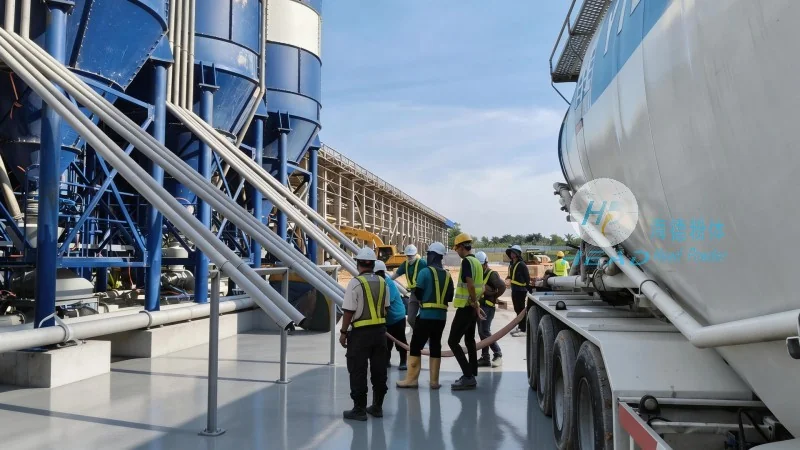
The limestone pneumatic conveying line operates on the principle of pneumatic transport, which involves the movement of bulk materials through a pipeline using a stream of air or gas. In this system, limestone powder is fed into a hopper, where it is then drawn into a pipeline by a vacuum or pressure source. The air flow, typically generated by a fan or blower, carries the limestone particles through the pipeline to the destination point, such as a storage silo or processing unit. The key components of this system include the hopper, the conveying pipeline, the air mover (vacuum or pressure), and the control system. The efficiency of the conveying process depends on factors like the air velocity, particle size, and the length and diameter of the pipeline. HeadPowder’s limestone pneumatic conveying lines are engineered to optimize these parameters, ensuring reliable and consistent material transport with minimal loss and degradation of the limestone product.
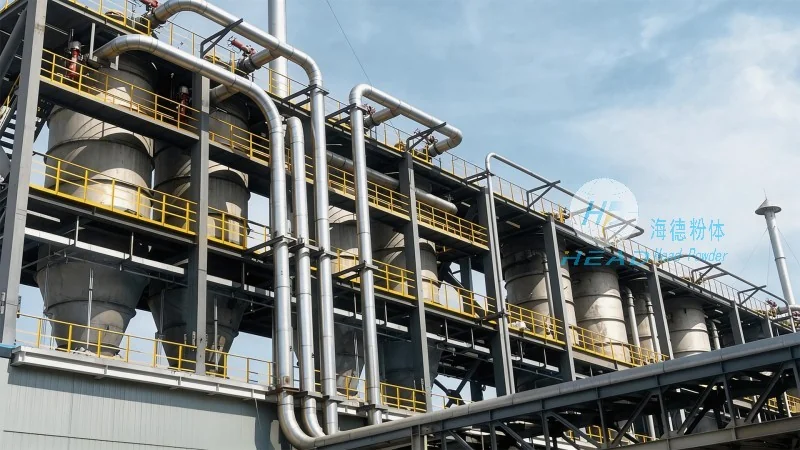
The limestone pneumatic conveying lines are designed to operate in diverse industrial settings, each with unique requirements and challenges. The working scene characteristics of these systems are tailored to meet the specific needs of different applications, ensuring optimal performance and safety. One of the primary characteristics is the ability to handle fine limestone powders, which are often prone to dust generation and caking. The conveying system is equipped with dust collection and filtration components to maintain air quality and prevent material buildup in the pipeline. Another important characteristic is the system’s adaptability to different material flow rates and distances. Whether transporting limestone from a quarry to a processing plant over short or long distances, the system can be configured to handle varying loads and speeds. The working scene also includes considerations for environmental factors, such as temperature and humidity, which can affect the material’s properties and the system’s performance. HeadPowder’s limestone pneumatic conveying lines are designed to operate under a wide range of environmental conditions, ensuring consistent performance and durability.
HeadPowder’s limestone pneumatic conveying lines offer several key features and advantages that make them a preferred choice for industrial applications. One of the main advantages is the high efficiency and reliability of the system. The pneumatic transport method allows for continuous and unattended operation, reducing labor costs and increasing production throughput. The system also minimizes material loss and degradation, as the limestone particles are not subjected to mechanical stress during transport. Another advantage is the flexibility of the system, which can be easily integrated with existing production lines and modified to accommodate changes in material flow requirements. The system is also designed for low maintenance, with components that are easy to access and replace, reducing downtime and maintenance costs. Additionally, the system is equipped with safety features, such as pressure relief valves and emergency shut-off mechanisms, to ensure safe operation and protect personnel and equipment.
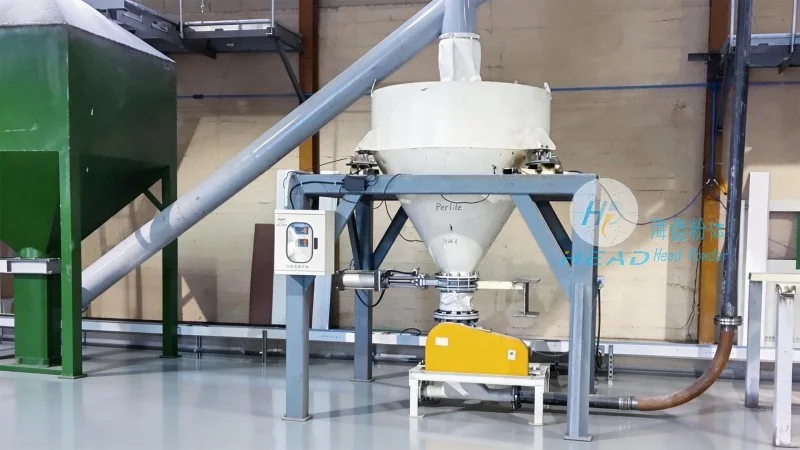
Limestone pneumatic conveying lines are widely used in various industrial applications, including cement production, chemical processing, and food processing. In cement production, the limestone is used as a raw material to produce clinker, which is then processed into cement. The pneumatic conveying system is used to transport the limestone from the quarry to the cement plant, where it is then ground into a fine powder. In chemical processing, the limestone is used as a filler or raw material in the production of various chemicals, such as calcium carbonate. The system is used to transport the limestone from storage silos to the processing units. In food processing, the limestone is used as a calcium supplement in the production of dairy products and other food items. The system is used to transport the limestone from storage to the processing line. In all these applications, the limestone pneumatic conveying line provides a reliable and efficient method of material transport, ensuring consistent quality and reducing operational costs.

 Shandong Headpowder Engineering Co., Ltd.
 156-6277-7102(Manager Zhang)
  0531-83386006
  Zhangqiu District, Jinan City, Shandong Province, China
telephone
WeChatconsult
top