With more than 10‑year industry experience, Shandong Headpowder delivers full‑service pneumatic‑conveying systems and blowers, undertaking nationwide turn‑key powder‑handling projects.
Silicon carbide (SiC) is a high-performance ceramic material widely used in various industrial applications due to its exceptional hardness, thermal stability, and chemical resistance. The efficient and reliable transport of SiC powders and granules is crucial for manufacturing processes, and pneumatic conveying systems offer a solution that minimizes dust generation and ensures product integrity. This article provides an overview of the design considerations and key components involved in the development of a silicon carbide pneumatic conveying system, highlighting the expertise of Shandong HeadPowder Engineering Co., Ltd. (referred to as HeadPowder) in this specialized field.
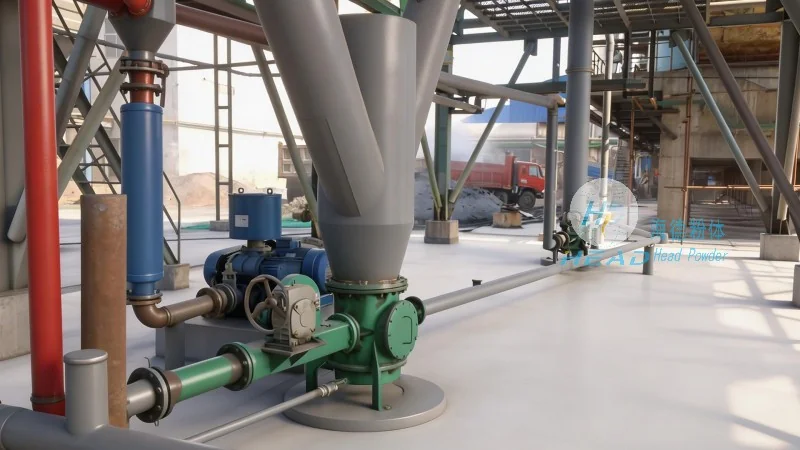
The successful design of a silicon carbide pneumatic conveying system depends on several critical factors that ensure optimal performance, safety, and longevity. First, the material characteristics of silicon carbide must be carefully considered. SiC particles are typically abrasive and have a high density, which influences the selection of conveying air velocity, pipe diameter, and material of construction. HeadPowder engineers take into account the particle size distribution, flowability, and moisture content of the SiC material to determine the appropriate air velocity and pressure drop across the system. For example, higher air velocities are often required for fine SiC powders to prevent clogging, while larger granules may be conveyed at lower velocities to reduce energy consumption.
A typical silicon carbide pneumatic conveying system consists of several key components, each playing a vital role in the overall operation. The primary components include a hopper or feeder for material storage and controlled discharge, a rotary airlock valve to regulate the flow of SiC into the conveying line, a venturi or pressure drop device to create the necessary air flow, and a receiver or silo for the discharged material. HeadPowder designs these components with precision, ensuring that each part is compatible with the abrasive nature of SiC. For instance, the hopper is often equipped with a cone or wedge to prevent material bridging, and the rotary airlock valve is made from wear-resistant materials such as stainless steel or hardened alloys to withstand the constant impact of SiC particles.
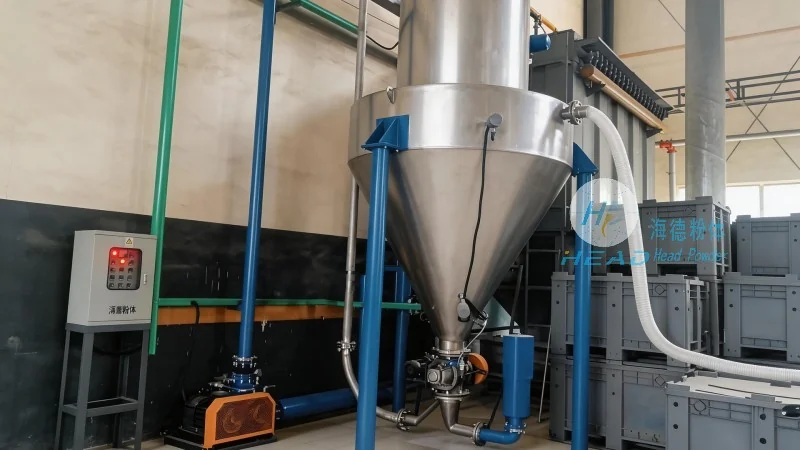
Given the abrasive properties of silicon carbide, the selection of materials for the conveying system is paramount. HeadPowder utilizes high-quality, wear-resistant materials throughout the system to minimize maintenance and extend operational life. The conveying pipes are typically made from stainless steel or special alloys with a smooth interior finish to reduce friction and particle attrition. The elbows and bends are designed with larger radii or replaced with flexible hoses to prevent particle accumulation and wear. Additionally, the system may incorporate liners or coatings on components that are most exposed to SiC, such as the hopper walls and valve seats, to enhance durability. This attention to material selection ensures that the system can handle the harsh conditions associated with SiC transport without frequent downtime or component replacement.
Modern pneumatic conveying systems for silicon carbide often incorporate advanced control and monitoring systems to optimize performance and ensure safety. HeadPowder integrates sensors and control panels that monitor air pressure, flow rate, and material level in real-time. These systems allow operators to adjust the conveying parameters dynamically, such as increasing air velocity during peak production or reducing it to conserve energy. The control systems also include alarms and safety interlocks to prevent overpressure or material blockages, which are critical in handling abrasive materials like SiC. By implementing these advanced controls, HeadPowder ensures that the system operates efficiently while maintaining the integrity of the silicon carbide product.
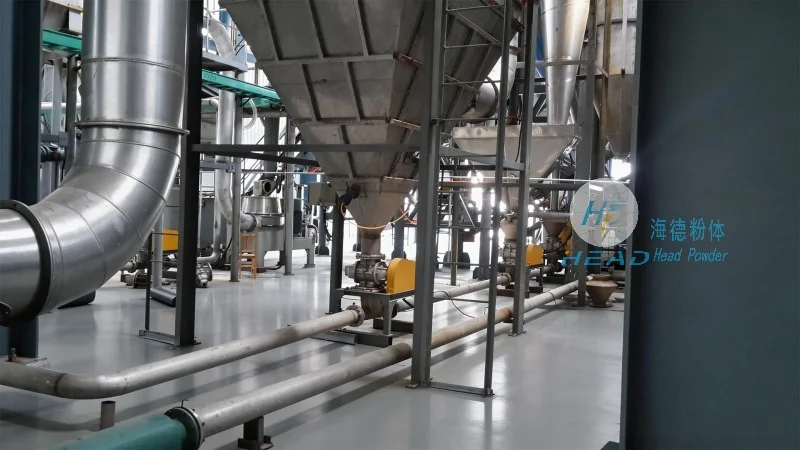
Each silicon carbide application has unique requirements, and HeadPowder specializes in providing customized pneumatic conveying solutions tailored to specific customer needs. Whether the application involves conveying fine SiC powders for ceramic manufacturing or larger granules for refractory production, HeadPowder engineers work closely with clients to understand their process parameters and design a system that meets their exact specifications. The company offers a range of system configurations, including dilute phase and dense phase conveying, to accommodate different material flow rates and distances. For example, a dilute phase system may be used for long-distance transport of fine SiC powders, while a dense phase system is preferred for short-distance transport of larger granules to minimize particle degradation. HeadPowder’s customization approach ensures that clients receive a system that is both efficient and cost-effective for their specific industrial application.
Silicon carbide pneumatic conveying equipment is a critical component in many industrial processes, and the design of such systems requires specialized knowledge and expertise. Shandong HeadPowder Engineering Co., Ltd. (HeadPowder) has established itself as a leader in the design and manufacturing of high-quality pneumatic conveying systems for silicon carbide and other abrasive materials. With a focus on material selection, system optimization, and customer-specific solutions, HeadPowder delivers reliable and efficient conveying systems that meet the demands of modern industrial applications. The company’s commitment to quality and innovation ensures that clients receive products that not only perform well but also provide long-term value. Based in Shandong, China, HeadPowder continues to serve clients worldwide with its expertise in pneumatic conveying technology, helping to enhance productivity and product quality in the silicon carbide industry.

 Shandong Headpowder Engineering Co., Ltd.
 156-6277-7102(Manager Zhang)
  0531-83386006
  Zhangqiu District, Jinan City, Shandong Province, China
telephone
WeChatconsult
top