With more than 10‑year industry experience, Shandong Headpowder delivers full‑service pneumatic‑conveying systems and blowers, undertaking nationwide turn‑key powder‑handling projects.
In the grain processing industry, particularly in the production and handling of wheat starch, pneumatic conveying technology is a critical equipment for ensuring efficient and safe material transport. HeadPowder (Shandong HeadPowder Engineering Co., Ltd.) as a professional manufacturer in the industry, is committed to providing reliable and efficient conveying solutions for users. This article will delve into the positive pressure conveying and negative pressure conveying, two mainstream pneumatic conveying methods, through comparative analysis, to help users understand the application characteristics and applicable scenarios of different conveying methods in wheat starch processing.
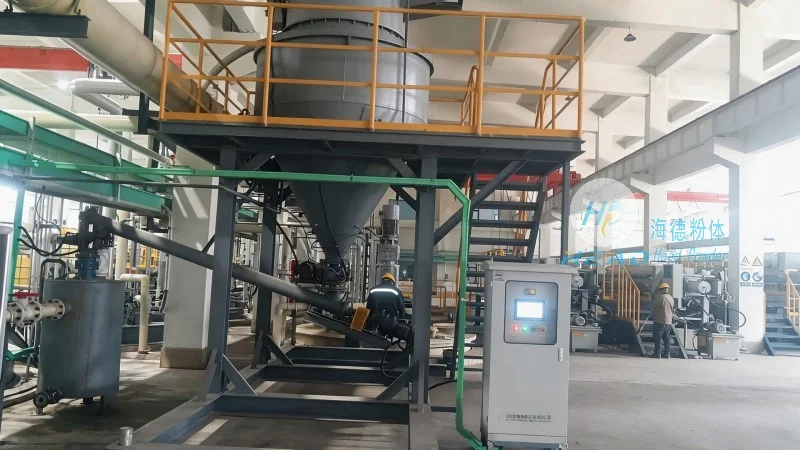
Positive pressure conveying, also known as pressurized pneumatic conveying, uses high-pressure airflow within the conveying pipeline to push materials from the feeding point to the unloading point. For wheat starch, a low-density powder material, positive pressure conveying has significant advantages. HeadPowder's positive pressure conveying equipment is typically equipped with high-pressure blowers, which can generate sufficient airflow pressure to ensure stable material flow in the pipeline. The system is suitable for long-distance, high-volume conveying tasks, such as transporting bulk materials from the production workshop to the warehouse. The advantage of positive pressure conveying lies in its high efficiency, enabling continuous and uninterrupted material transport with reduced manual intervention. Additionally, the positive pressure system usually adopts a closed pipeline, effectively preventing dust dispersion and ensuring workplace safety. HeadPowder's positive pressure conveying equipment also features adjustable airflow speed and pressure control functions, allowing users to adjust conveying parameters according to actual needs to optimize conveying effects.
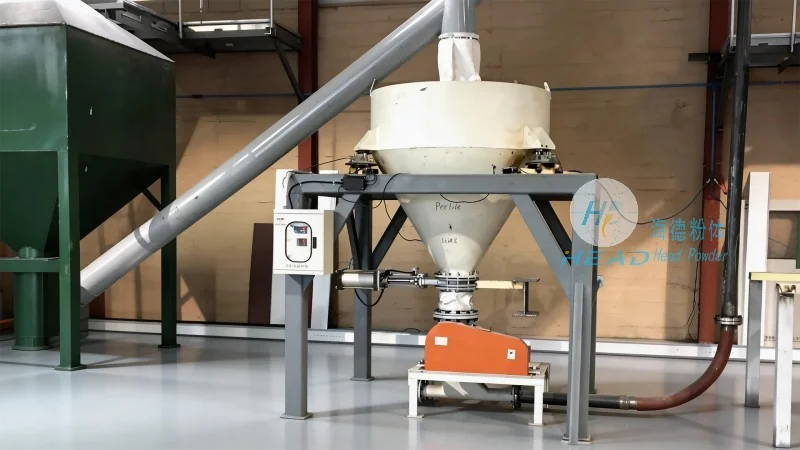
Negative pressure conveying, also known as suction pneumatic conveying, uses negative pressure airflow within the conveying pipeline to draw materials from the feeding point into the pipeline and transport them to the unloading point. Unlike positive pressure conveying, the negative system typically sets an aspirator at the feeding end, using a blower to generate negative pressure and draw materials into the pipeline. For wheat starch, a powder that is easily drawn, negative pressure conveying has unique applicability. For example, when collecting materials from storage silos or production equipment, the negative system can easily draw materials from the source into the pipeline, avoiding the complexity of manual cleaning or mechanical handling. The advantage of negative pressure conveying lies in its long conveying distance and lower requirements for material dust generation, suitable for processing materials prone to dust. HeadPowder's negative pressure conveying equipment is typically equipped with efficient blowers and filtration systems to ensure dust control during the conveying process. Additionally, the negative system has less impact on material particle integrity during conveying, suitable for applications requiring material integrity. However, the energy consumption of negative pressure conveying is usually higher than that of positive pressure systems, and there may be dust accumulation risks in the pipeline, requiring regular maintenance.
When evaluating positive and negative pressure conveying systems, multiple key parameters need to be considered to determine the most suitable conveying method for wheat starch processing. First, conveying distance is a crucial factor. Positive pressure conveying is typically suitable for longer distances (up to hundreds of meters), while negative pressure conveying performs better over medium distances (tens to hundreds of meters). Second, material characteristics affect conveying effects. Wheat starch has a low density (approximately 1.5-1.6 g/cm³) and is easily flowable, making positive pressure conveying more effective in overcoming pipeline resistance. Negative pressure conveying is more suitable for handling materials with higher density or greater viscosity. Third, energy consumption: positive systems require higher pressure maintenance, resulting in higher energy consumption compared to negative systems, although negative systems may need larger power blowers for long-distance conveying. Fourth, system complexity and maintenance costs. Positive systems typically require more complex pressure control devices, but negative systems may require more frequent filtration and maintenance. HeadPowder's engineers will consider these parameters based on user's specific needs to provide customized conveying solutions for wheat starch processing.
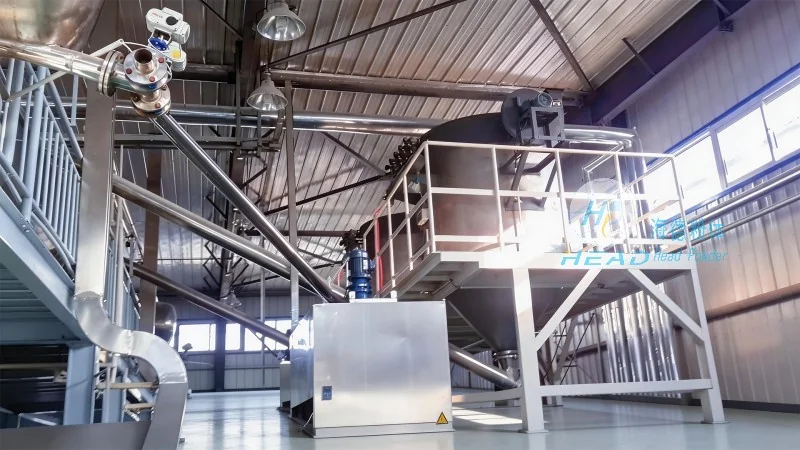
As Shandong HeadPowder Engineering Co., Ltd. (HeadPowder), we specialize in powder engineering technology research and equipment manufacturing, with years of industry experience. The company is headquartered in Shandong, China, committed to providing high-quality pneumatic conveying equipment to customers worldwide. HeadPowder's positive and negative pressure conveying equipment adopts advanced manufacturing processes to ensure high reliability and long service life. We offer one-stop services from system design, equipment manufacturing to installation and commissioning, helping users achieve efficient and safe material transport. For wheat starch processing enterprises, choosing HeadPowder's conveying equipment means obtaining professional technical support, customized solutions, and reliable after-sales service. We understand the specific needs of different enterprises, optimizing conveying parameters and system configuration to ensure stable and efficient material transport. HeadPowder is always customer-focused, committed to promoting the application of pneumatic conveying technology in wheat starch processing to enhance the overall production efficiency and safety of the industry.

 Shandong Headpowder Engineering Co., Ltd.
 156-6277-7102(Manager Zhang)
  0531-83386006
  Zhangqiu District, Jinan City, Shandong Province, China
telephone
WeChatconsult
top