With more than 10‑year industry experience, Shandong Headpowder delivers full‑service pneumatic‑conveying systems and blowers, undertaking nationwide turn‑key powder‑handling projects.
Shandong HeadPowder Engineering Co., Ltd., commonly known as HeadPowder, is a specialized engineering firm based in Shandong, China. The company focuses on providing advanced solutions for the handling and transportation of powder explosives through pneumatic conveying systems.
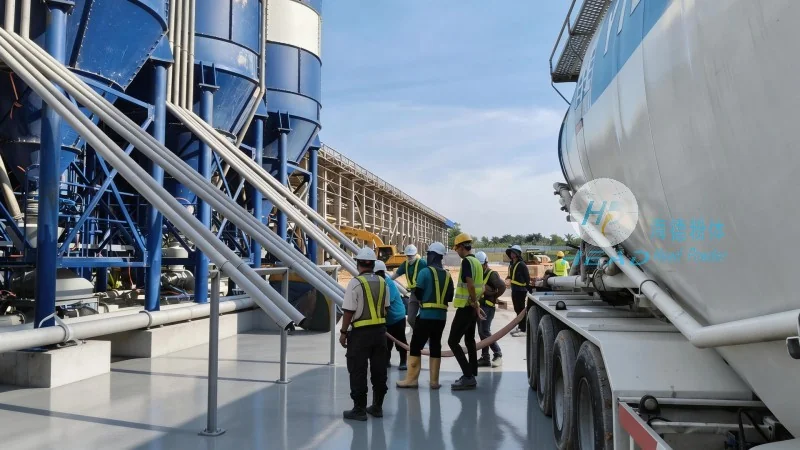
Pneumatic conveying is a critical technology in the powder explosive industry, enabling the safe and efficient movement of materials like gunpowder, smokeless powder, and other explosive powders. Two primary methods dominate this field: vacuum (or suction) conveying and positive pressure (or pressure) conveying. Understanding the advantages and disadvantages of each approach is essential for selecting the most suitable system for specific operational needs.
Vacuum conveying operates by creating a negative pressure in the conveying line, drawing material from the source to the destination. This method is particularly effective for applications requiring gentle handling of delicate or sensitive powders, as the low pressure and controlled airflow minimize particle breakage and degradation. One of the key advantages is its ability to convey materials over longer distances with relatively low energy consumption, making it suitable for large-scale operations where the source and destination are far apart.
Another benefit of vacuum systems is their flexibility in handling multiple material sources. The suction mechanism can draw material from several points simultaneously, which is advantageous in complex production lines where powders are generated at various locations. Additionally, vacuum conveying is often more cost-effective for short to medium-distance transfers, as it requires less powerful equipment compared to positive pressure systems.
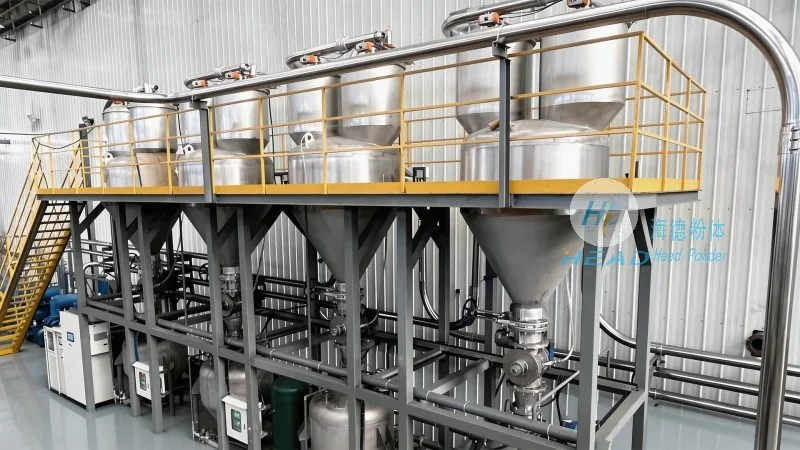
However, vacuum conveying also has notable limitations. The primary drawback is its lower conveying capacity compared to positive pressure systems, which can be a constraint in high-volume production environments. The system's performance is highly dependent on the source material's characteristics, such as moisture content and particle size, as these factors can affect the airflow and material flow rates. Furthermore, vacuum systems are more susceptible to blockages and clogging, especially when handling powders with high moisture or cohesive properties. Regular maintenance and cleaning are necessary to prevent system downtime, which can increase operational costs over time.
Positive pressure conveying, as the name implies, uses compressed air to push material through the conveying line. This method is ideal for applications requiring high conveying rates and the ability to handle abrasive or corrosive powders. The primary advantage is its superior capacity and efficiency in moving large volumes of material quickly, making it suitable for high-throughput production lines.
Another key benefit of positive pressure systems is their ability to handle materials with higher moisture content or cohesive properties. The higher pressure and airflow can break up agglomerates and prevent clogging, ensuring consistent material flow. Additionally, positive pressure conveying is less affected by changes in source material characteristics, as the system's performance is more stable under varying conditions.
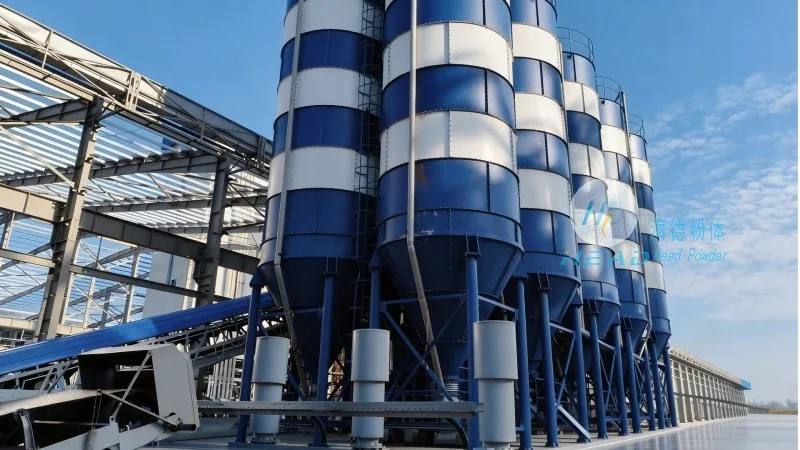
However, positive pressure systems come with significant drawbacks. The most notable limitation is their higher energy consumption compared to vacuum systems, as they require powerful air compressors and higher air pressure to maintain material movement. This can lead to increased operational costs, especially for large-scale operations. Another disadvantage is the potential for particle degradation due to the higher impact forces and friction within the conveying line. For sensitive powders, this can result in reduced product quality and performance. Furthermore, positive pressure systems are less flexible in handling multiple material sources, as they typically require a dedicated line for each source, increasing the complexity and cost of system design.
When selecting a pneumatic conveying system for powder explosives, the choice between vacuum and positive pressure methods depends on several factors, including the material characteristics, conveying distance, production volume, and operational costs. For applications requiring gentle handling of sensitive powders over long distances with low energy consumption, vacuum conveying is often the preferred option. Conversely, for high-volume production lines handling abrasive or cohesive materials over shorter distances, positive pressure conveying may be more suitable.
HeadPowder, as a specialized engineering firm, offers customized pneumatic conveying solutions tailored to the specific needs of powder explosive manufacturers. Our experts conduct thorough assessments of material properties, operational requirements, and site conditions to recommend the most efficient and cost-effective system. Whether you need a vacuum or positive pressure system, our team ensures that the chosen solution meets safety standards and maximizes operational efficiency.

 Shandong Headpowder Engineering Co., Ltd.
 156-6277-7102(Manager Zhang)
  0531-83386006
  Zhangqiu District, Jinan City, Shandong Province, China
telephone
WeChatconsult
top