With more than 10‑year industry experience, Shandong Headpowder delivers full‑service pneumatic‑conveying systems and blowers, undertaking nationwide turn‑key powder‑handling projects.
Polycrystalline silicon, a critical material in the photovoltaic industry, requires efficient and reliable transport methods to ensure smooth production processes. Among various conveying technologies, pneumatic conveying systems have emerged as a preferred solution due to their ability to handle fine powders like polycrystalline silicon with minimal contamination and high throughput. This article explores the different types of pneumatic conveying systems used in polycrystalline silicon transport and their practical applications, highlighting the expertise of Shandong HeadPowder Engineering Co., Ltd. in providing tailored solutions for the industry.
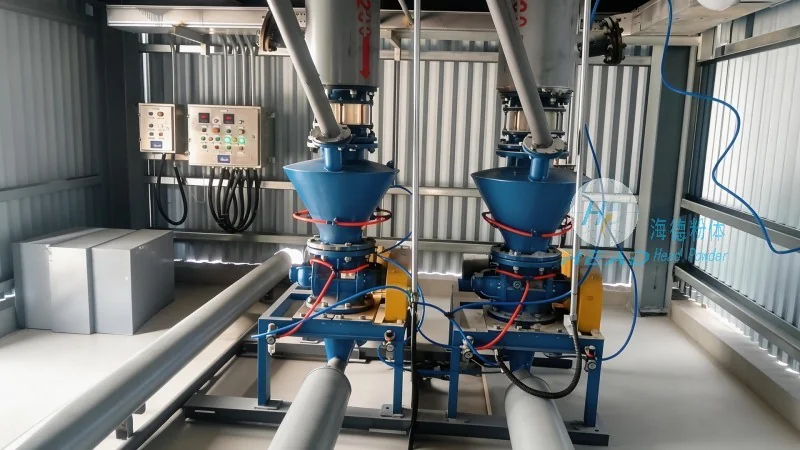
Pneumatic conveying systems utilize air or other gases to transport bulk materials through a pipeline. For polycrystalline silicon, which is typically a fine powder with specific particle size and density characteristics, the choice of system type is crucial to maintain material quality and operational efficiency. The primary types of pneumatic conveying systems include dilute-phase, dense-phase, and hybrid systems, each with distinct advantages and applications.
Dilute-phase systems operate by suspending the material in a high-velocity air stream, typically at velocities exceeding 20 m/s. This method is suitable for transporting polycrystalline silicon over long distances with minimal pressure drops. The system is characterized by low pressure requirements and is ideal for applications where the material is to be transported in a continuous flow without significant segregation or degradation. Shandong HeadPowder Engineering Co., Ltd. specializes in designing dilute-phase systems that optimize air consumption and ensure consistent material transport, minimizing energy costs while maintaining high efficiency.
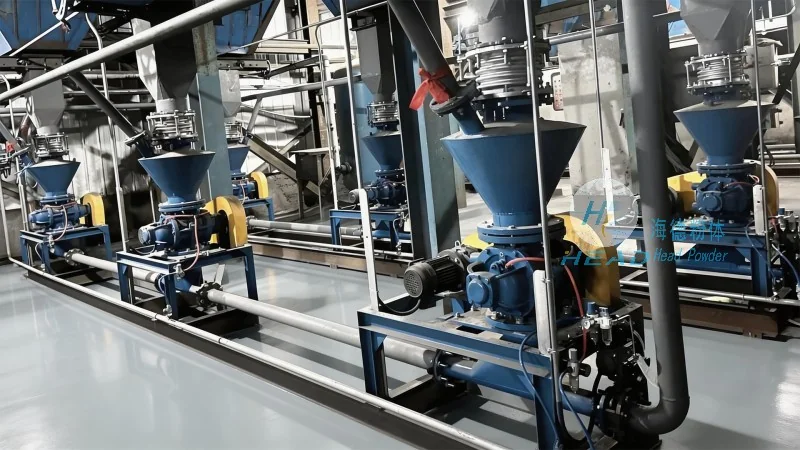
Dense-phase systems, also known as low-velocity or pressure-assisted systems, transport material in a more concentrated state, often at velocities below 10 m/s. This approach is particularly effective for handling sensitive materials like polycrystalline silicon, as it reduces particle impact and friction, thereby minimizing attrition and maintaining particle integrity. The system operates under higher pressure and is commonly used for short to medium distance transport, where precise control over material flow is essential. HeadPowder's dense-phase solutions are engineered to provide gentle handling, ensuring that the polycrystalline silicon remains free from agglomeration or damage during transit.
Hybrid systems combine elements of both dilute and dense-phase operations, offering flexibility in handling varying material characteristics and transport requirements. These systems can switch between low and high velocities as needed, adapting to different pipeline lengths and material flow rates. For polycrystalline silicon applications, hybrid systems are advantageous when dealing with complex transport scenarios, such as combining long-distance transport with precise dosing at the destination. Shandong HeadPowder Engineering Co., Ltd. develops hybrid solutions that leverage advanced control technologies to enhance operational efficiency and material handling capabilities, catering to the diverse needs of the photovoltaic industry.
The application of pneumatic conveying systems in polycrystalline silicon production encompasses several key stages, from raw material handling to finished product delivery. In the initial stages, dilute-phase systems are often used to transport raw silicon materials from storage silos to processing facilities, ensuring a continuous supply of feedstock. During the production process, dense-phase systems may be employed to move intermediate products, such as silicon wafers or slurry, between different processing units, maintaining product quality and preventing contamination. At the final stage, hybrid systems can be utilized for packaging and distribution, where precise control over material flow is critical to meet customer specifications.
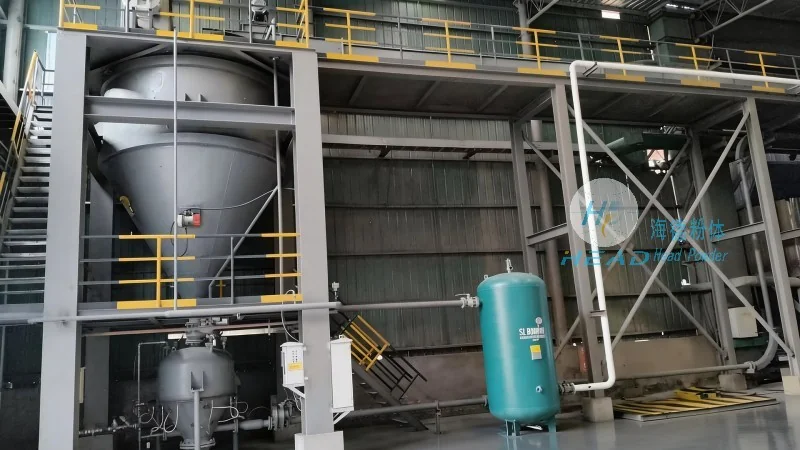
The selection of an appropriate pneumatic conveying system for polycrystalline silicon depends on several factors, including material properties, transport distance, required throughput, and operational environment. Material properties such as particle size distribution, density, and moisture content significantly influence system performance, as they affect air velocity, pressure, and pipeline design. Transport distance is another critical factor, as long-distance transport may require higher air velocities and more robust pipeline infrastructure, while short-distance transport can utilize lower velocities and simpler designs. Throughput requirements, determined by production capacity, also play a role, as higher throughput demands more efficient systems with optimized air flow and material handling capabilities. Additionally, operational environment considerations, such as the need for dust control or explosion-proofing, may influence system selection, especially in industrial settings where safety is paramount.
Compared to traditional mechanical conveying methods, pneumatic conveying systems offer several advantages for polycrystalline silicon transport. One of the primary benefits is the ability to handle fine powders without the need for additional equipment like hoppers or feeders, reducing the risk of material degradation and contamination. The systems also provide flexibility in terms of layout, as they can be installed in various configurations, including vertical, horizontal, or mixed orientations, to accommodate different plant designs. Furthermore, pneumatic conveying systems are capable of transporting materials over long distances with minimal pressure drops, reducing energy consumption and operational costs. The gentle handling of materials in dense-phase systems minimizes particle attrition and agglomeration, preserving the quality of polycrystalline silicon, which is essential for downstream processing and product performance.

 Shandong Headpowder Engineering Co., Ltd.
 156-6277-7102(Manager Zhang)
  0531-83386006
  Zhangqiu District, Jinan City, Shandong Province, China
telephone
WeChatconsult
top