With more than 10‑year industry experience, Shandong Headpowder delivers full‑service pneumatic‑conveying systems and blowers, undertaking nationwide turn‑key powder‑handling projects.
Lightweight calcium carbonate (LCC) is a widely used industrial material, often employed in applications such as papermaking, plastics, and coatings due to its high whiteness and low density. Handling this material efficiently is crucial for maintaining production quality and minimizing operational costs. Pneumatic conveying equipment offers a reliable solution for transporting LCC, especially when dealing with fine powders that are prone to dust and clogging in traditional mechanical systems. This article provides an overview of the structure and working principle of pneumatic conveying equipment designed for LCC, highlighting key components and their functions.
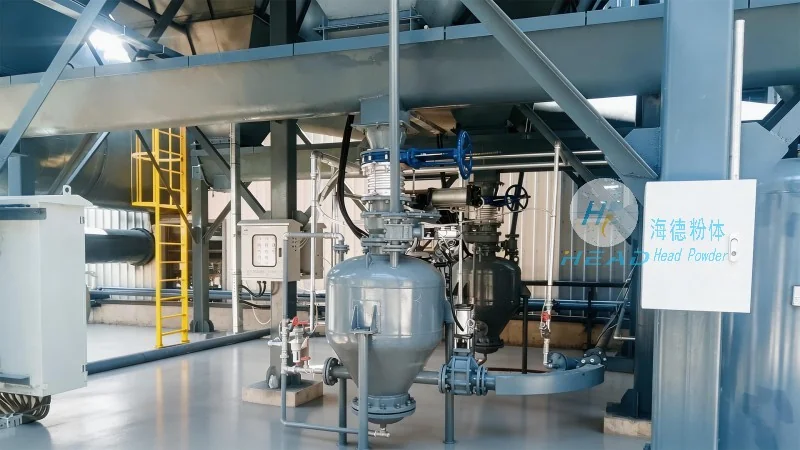
The core of a pneumatic conveying system for lightweight calcium carbonate consists of several interconnected components that work in tandem to move the material from the source to the destination. The primary components include a material feeder, a conveying line, a separation system, and a dust collection unit. Each component plays a critical role in ensuring efficient and safe material transport.
1. Material Feeder: The feeder is responsible for introducing the LCC powder into the conveying line. For LCC, which can be fine and cohesive, a rotary valve or a screw feeder is commonly used. These devices ensure a consistent flow rate, preventing overloading or underloading that could disrupt the conveying process. The feeder is typically equipped with a hopper to store the material, allowing for continuous operation without frequent stops.

2. Conveying Line: The conveying line is the main pathway through which the LCC is transported. It is usually made of stainless steel or other corrosion-resistant materials to withstand the abrasive nature of the powder. The line can be either horizontal or vertical, depending on the layout of the facility. The diameter of the line is carefully selected based on the particle size and flow rate to minimize pressure drop and ensure smooth transport.
3. Separation System: At the end of the conveying line, a separation system is used to separate the LCC from the air stream. This is typically achieved through a cyclone separator or a bag filter. The cyclone uses centrifugal force to separate the heavier powder from the lighter air, while the air is then discharged through a vent. The separated LCC is collected in a receiving hopper for further processing.
4. Blower or Fan: The blower or fan generates the necessary air pressure to move the LCC particles. The pressure and airflow rate are adjusted based on the material characteristics and the distance to be covered. For LCC, which has a low bulk density, a higher airflow rate may be required to maintain a stable conveying velocity.
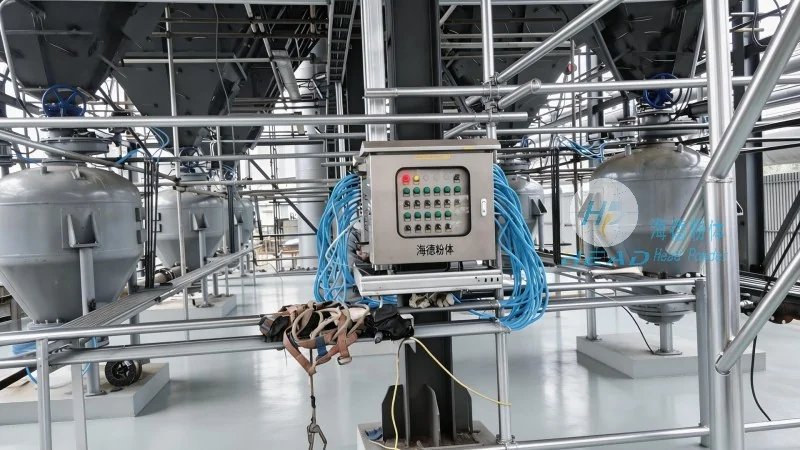
Compared to traditional mechanical conveying methods, pneumatic systems offer several advantages when handling lightweight calcium carbonate. First, they eliminate the need for moving parts in contact with the material, reducing wear and tear and minimizing the risk of contamination. This is particularly important for food-grade or pharmaceutical applications where purity is paramount. Second, pneumatic conveying can handle fine powders that are difficult to transport using screw or belt conveyors, as the air stream helps to keep the particles suspended and prevents clogging. Third, the system is flexible and can be easily integrated into existing production lines, allowing for changes in production volume or material type without major modifications.
Shandong HeadPowder Engineering Co., Ltd. is a leading manufacturer of specialized powder handling equipment, including pneumatic conveying systems for lightweight calcium carbonate. With years of experience in the industry, the company has developed advanced solutions tailored to the unique challenges of handling fine powders. The company’s products are designed with durability, efficiency, and safety in mind, ensuring reliable performance in various industrial applications. HeadPowder’s commitment to quality and innovation has made it a trusted partner for businesses seeking to optimize their material handling processes. Located in Shandong, China, the company leverages its local expertise and resources to provide comprehensive support and after-sales service to its clients worldwide.

 Shandong Headpowder Engineering Co., Ltd.
 156-6277-7102(Manager Zhang)
  0531-83386006
  Zhangqiu District, Jinan City, Shandong Province, China
telephone
WeChatconsult
top