With more than 10‑year industry experience, Shandong Headpowder delivers full‑service pneumatic‑conveying systems and blowers, undertaking nationwide turn‑key powder‑handling projects.
For industries dealing with resin powders, efficient and reliable material handling is crucial. The process of pneumatic conveying offers a solution that minimizes dust, reduces contamination risks, and enhances operational safety. This article focuses on the design calculations and equipment selection for resin powder pneumatic conveying systems, providing a comprehensive guide for engineers and facility managers.
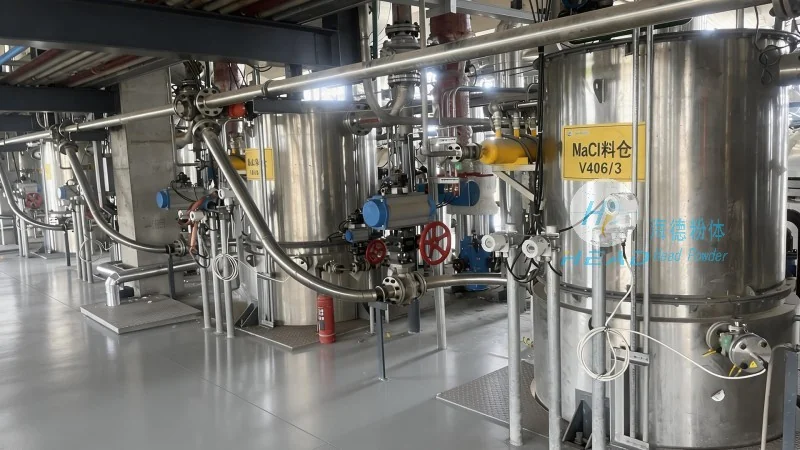
The successful implementation of a resin powder pneumatic conveying system begins with accurate design calculations. These calculations ensure the system operates efficiently, maintains material quality, and meets production requirements. Several critical factors must be considered during the design phase, including material properties, system layout, and operational parameters.
First, the physical properties of the resin powder are essential. Parameters such as particle size distribution, bulk density, and flowability significantly impact the conveying performance. For instance, fine resin powders may require higher air velocities to prevent settling or blockages, while coarser particles can be conveyed at lower velocities. The bulk density of the material determines the air volume needed to achieve the desired conveying rate. Flowability, often measured by the angle of repose or Carr's index, indicates how easily the powder flows in the system, affecting the design of hoppers, feeders, and pipelines.
Second, the system layout and pipeline configuration are critical. The distance between the source and destination, the number of bends, and the vertical rise all influence the air pressure and velocity requirements. Horizontal and vertical pipeline sections must be sized appropriately to maintain the material's suspension in the air stream. For long-distance conveying, the use of booster units or multiple stages may be necessary to maintain sufficient air pressure. The design also considers the type of conveying system—whether it's a pressure or vacuum system—based on the application and material characteristics.
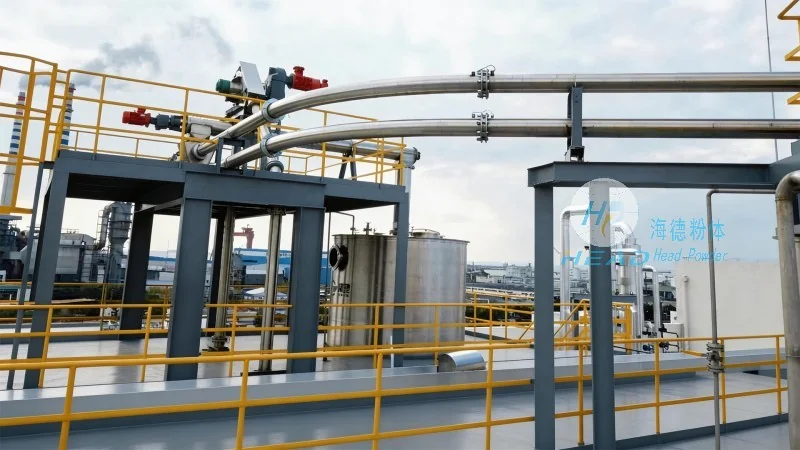
Third, operational parameters like conveying rate, air flow rate, and pressure drop are calculated to ensure the system meets production demands. The conveying rate is determined by the required material throughput, which is often specified by the end-user or production schedule. The air flow rate is calculated based on the material's bulk density and the desired velocity, using equations such as the "air velocity method" or "pressure drop method." The pressure drop across the system is a key indicator of energy consumption and system efficiency. Engineers use empirical formulas or software tools to calculate pressure drop, considering factors like pipe diameter, length, fittings, and bends. For example, the air velocity method calculates the required air velocity based on the material's particle size and density. The formula is often expressed as: \( v = K \times d^{-0.5} \), where \( v \) is the air velocity, \( d \) is the particle diameter, and \( K \) is a constant that depends on the material's properties. This method ensures that the air velocity is sufficient to keep the particles suspended, preventing settling in the pipeline. The pressure drop method, on the other hand, calculates the pressure required to overcome the resistance in the system. The pressure drop across a straight pipe is given by the Darcy-Weisbach equation: \( \Delta P = f \times \frac{L}{D} \times \frac{\rho v^2}{2} \), where \( \Delta P \) is the pressure drop, \( f \) is the friction factor, \( L \) is the pipe length, \( D \) is the pipe diameter, and \( \rho \) is the air density. The friction factor depends on the Reynolds number and the pipe roughness, which are influenced by the material's presence in the air stream.
Choosing the right equipment is vital for the performance and longevity of a resin powder pneumatic conveying system. The selection process involves evaluating various components, each designed to handle specific challenges in the conveying process. The key equipment includes feeders, hoppers, pipelines, filters, and control systems.
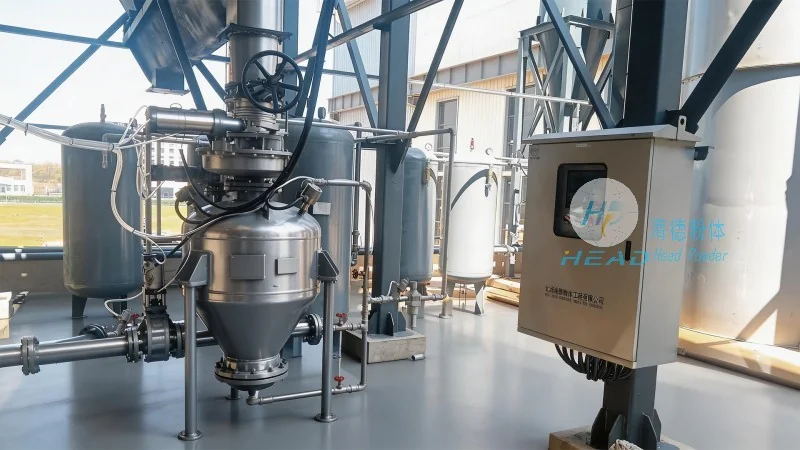
Feeding equipment is critical for consistent material introduction into the system. For resin powders, screw feeders, rotary valves, or vibratory feeders are commonly used. Screw feeders provide a continuous flow and are suitable for fine powders, while rotary valves offer precise control and can handle varying feed rates. The choice depends on the material's flowability and the required conveying rate. Hoppers are used to store and feed the resin powder into the feeder. The design of hoppers, including the hopper angle and discharge design, must prevent material bridging or caking, which can disrupt the conveying process. For cohesive resin powders, special hopper designs with internal agitators or air knives may be necessary to maintain flow.
Pipelines are the main conduits for transporting the resin powder. The material and diameter of the pipelines are selected based on the conveying velocity and pressure requirements. Stainless steel or plastic pipes are commonly used due to their resistance to corrosion and wear from the resin powder. The diameter is determined by the air velocity and the material's bulk density, ensuring the powder remains suspended in the air stream. Properly sized pipelines minimize pressure drop and energy consumption. Fittings such as elbows, tees, and reducers are used to change the direction or size of the pipeline, and their selection affects the overall pressure drop and system efficiency.
Filters and dust collectors are essential for maintaining air quality and preventing material loss. The resin powder is often fine and can easily escape through the system, leading to contamination and environmental issues. Cartridge filters or baghouse filters are commonly used to capture the powder particles from the exhaust air. The filter capacity must be matched to the system's air flow rate and the powder's characteristics. Regular maintenance of the filters is necessary to ensure the system operates efficiently and meets environmental regulations.

 Shandong Headpowder Engineering Co., Ltd.
 156-6277-7102(Manager Zhang)
  0531-83386006
  Zhangqiu District, Jinan City, Shandong Province, China
telephone
WeChatconsult
top